The power of three… tzatziki
In science lessons in school, we’re always taught how an experiment must be undertaken three times in order for the result to be reliable. In English, we’re taught how adjectives, lists or any form of writing should include a composition of three items, the rhythmic structure being optimum in written prose. Diversifying, the number three is considered a lucky number in feng shui and for the Chinese, being tied to ideas of growth and health. In Greek, the numbers 3 has great importance also. To begin with, in religious realms, consider the holy triad or trinity, the three magi or wise men. In Greek mythology, Zeus, Poseidon and Hades- three brothers- divided up the world between them- the sky, sea and underworld. Fast forward to ancient Greece and Pythagoras- quite apart from his theorem- determined human existence according to birth, life and death. And a person’s virtue was the sum of harmony, wisdom and understanding.
Thus, the number three has been integral to the way we see the world for many a century and for many a culture. Following in this trend, this is the first blog post of a series of three ingredient, three step, three(ish) minute preparation recipes.
---
It took me almost thirty years to realise how easy ultra-flavoursome, healthy dishes were to make. Things like tzatziki, hummus, aubergine dip, protein snacks, and fermented foods. Fermentation especially required a degree of alchemy which I felt unqualified to produce. But these foods are so simple and so quick, I almost feel guilty serving them to friends, as the time spent producing them looks far more than I actually invested.
I sit here writing this first entry whilst watching the Wimbledon men’s final, swapping strawberries and cream for homemade courgette fritters and tzatziki and pondering on how fabulous this summer is turning out to be. I began Philotrophie at the end of 2025 to produce Greek yoghurt as faithful to the mountainous original as it is possible to create in the UK. Think terracotta pots. Sheep milk. Fermentation. And not much else really. Apart from hundreds of years of family tradition and pride. Yoghurt being the main product we produce, during the early stages of the business we were left with a few pots spare. Breakfast and dessert dishes are perhaps the most obvious way to enjoy such a special yoghurt. Thus, I spent time experimenting, alchemising, and honing alternative recipes and ways to enjoy our yoghurt. Some showing it off as the main ingredient- such as tzatziki- and some where the yoghurt provides the background richness within a wider ingredient list, such as within a quiche or cake.
Let’s begin with dips…
Tzatziki
Usually used as a side dip with dishes like meatballs, courgette fritters, any savoury Greek pie, raw carrot sticks, celery sticks, roasted vegetable chunks, hunks of bread… I could continue…
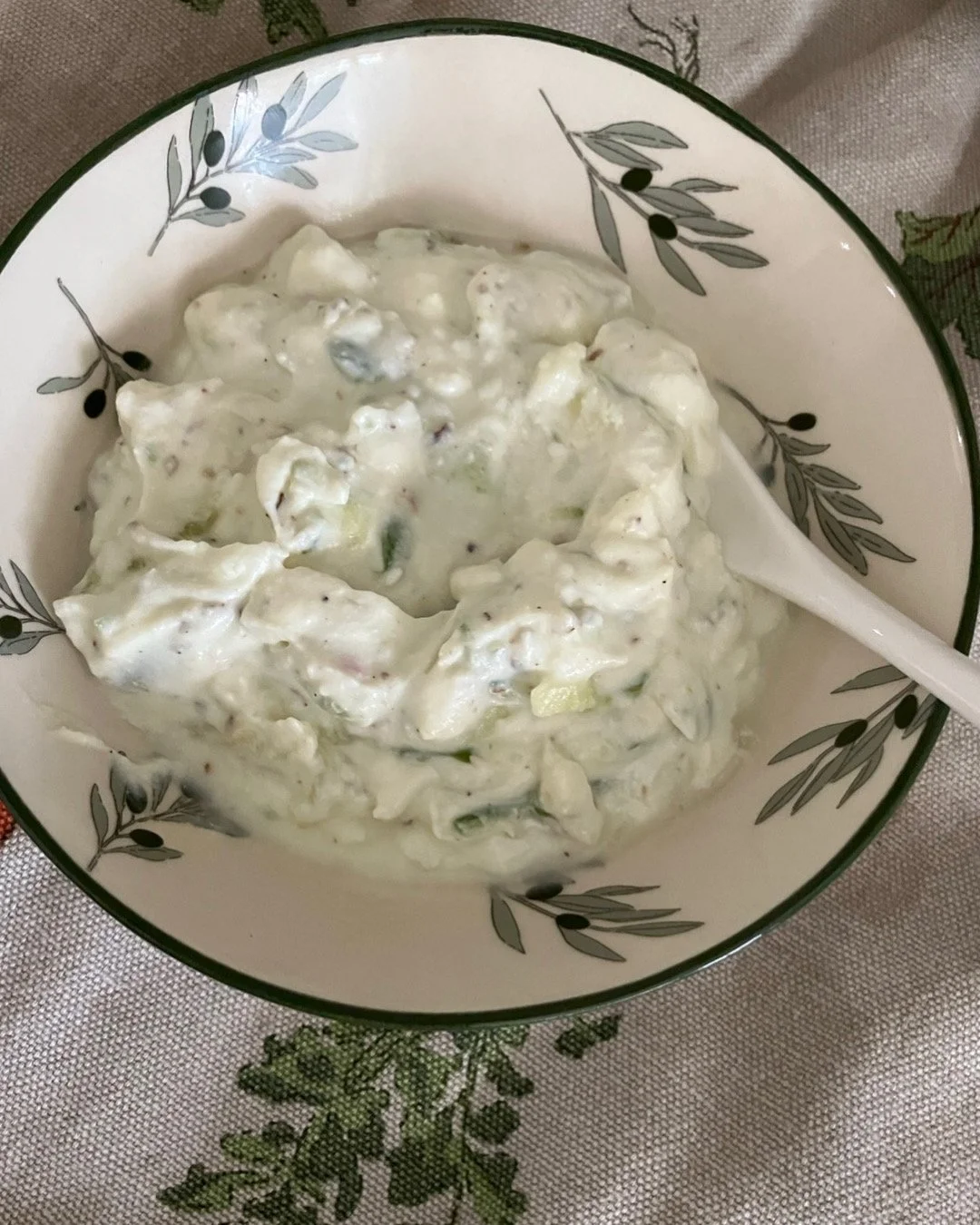
One recipe we use a lot at home, and is a particular favourite of mine, is tzatziki. Now, obviously, I am biased, but the magic ingredient here is the sheep milk yoghurt, produced by Philotrophie in the Cotswolds. It contributes a depth of flavour to the dip, brought about by its tanginess and rich baseline, and a thickness you won’t find in supermarket- or even restaurant- versions. This makes THE BEST tzatziki in the world. Fact. A recipe is only ever as good as the ingredients within it. This is why our yoghurt makes so much of a difference. It’s richer but somehow fresher. It’s creamier and feels more authentic.
Three ingredients. That’s all tzatziki is. It’s embarrassing how simplistic it is. Yoghurt, garlic, cucumber. Cucumber brings the freshness. Garlic, the bite. And yoghurt, the tanginess.
For those of you who like to know quantities, I apologise. I go by eye and by taste testing. The following ratios will result in enough tzatziki for two very hungry people or 4 moderately hungry, when used as an appetiser or side dish.
- I use 1 pot of the 250g yoghurt to make a bowl of tzatziki.
- With that, usually half a garlic clove is enough but obviously this depends on the size of the clove! Mash or puree the garlic, but definitely finely chopping does not seem to be sufficient- you really need it to blend into the yoghurt.
- Then the cucumber- usually about an inch of grated green goodness should be enough - again, however much you’re happy with, about an inch of cucumber should do it but there’s no harm in adding more.
Now, I said three ingredients. And it’s true, these all you need for a good tzatziki...
However, if you are feeling really decadent or particularly Mediterranean, a good splash of olive oil enhances it to a new level. Now, we’ve done our research with olive oil. As you can imagine, with half our family being Greek, the oil we use is extremely important. The strength of a marriage very much correlates to the quality of the olive oil found in the kitchen. And we have tried many, many, many imported olive oils. And the best we have found – and no, I don’t have any affiliation and am not paid to advertise them- is Honest Toil. From Greece, obviously. You can order directly from them, and they also have some really artistic limited edition oil cans!
So, you’ve mixed the yoghurt, garlic, cucumber and olive oil… now you may wish to add a good grating of black pepper and a touch of salt. These won’t be unwelcome but are not necessary. Some add a drop or two of lemon juice, but I find it doesn’t need it. That is the recipe. It’s seriously that simple. And it will definitely be the best tzatziki you’ve ever tasted.
Post script:
If you’ve kept your tzatziki in the fridge a while, the whey of the yoghurt may begin to separate from the rest of the dip. If this happens, just mix it up again with a spoon; the whey is the healthiest part of the yoghurt so don’t be put off by the separation! A good stir and it’ll be as good as new.